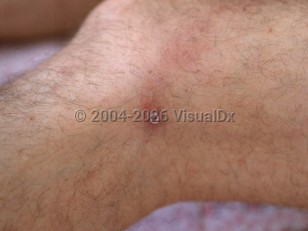
Mediterranean spotted fever (MSF), also known as boutonneuse fever, Marseilles fever, Kenya tick typhus, and Indian tick typhus, is an acute zoonotic infection caused by the obligate intracellular bacterium Rickettsia conorii and transmitted to humans by the brown dog tick Rhipicephalus sanguineus.
Rickettsia conorii has 4 subspecies: R conorii subsp conorii (Malish strain), R conorii subsp israelensis (Israeli spotted fever strain), R conorii subsp caspia (Astrakhan fever), and R conorii subsp indica (Indian tick typhus).
The disease is classified within the spotted fever group of rickettsial infections and is endemic in the Mediterranean basin, particularly in southern Europe, the Middle East, North Africa, and the Indian subcontinent. Cases have also been reported in several neighboring and more distant regions, including Jordan, Iran, Sicily, Portugal, Spain, Bulgaria, Tunisia, Crete, as well as parts of sub-Saharan Africa, and Asia. In temperate climates, the frequency of infection increases in the summer months.
Contact with dogs increases the risk of MSF. The infection occurs more commonly in male adults and children, and cases among travelers to endemic regions are well documented. The incubation period can range from 1-16 days, with a mean presentation at 6 days following tick bite.
Patients with MSF present with a triad of abrupt onset of fever, an exanthematous eruption, and an inoculation eschar at the site of the tick bite. Early in the course of the illness, there may be headache, arthralgia, myalgia, gastrointestinal symptoms, local lymphadenopathy, hepatomegaly, and splenomegaly.
Although MSF is generally mild to moderate, particularly in children, severe disease may occur in adults. Complications include encephalitis or meningoencephalitis, acute renal injury, myocarditis, ocular involvement (uveitis, chorioretinitis), respiratory complications, and shock. Case fatality rates can reach approximately 20% among hospitalized adults.
Risk factors for severe disease include advanced age, diabetes (type 1, type 2), chronic cardiac or liver disease, chronic alcohol use disorder, renal failure, glucose‑6‑phosphate dehydrogenase deficiency, immunocompromise, and delayed or inadequate therapy. MSF is not often fatal, except in older adult patients.
Mediterranean spotted fever
Alerts and Notices
Important News & Links
Synopsis

Codes
ICD10CM:
A77.1 – Spotted fever due to Rickettsia conorii
SNOMEDCT:
186774005 – Boutonneuse fever
A77.1 – Spotted fever due to Rickettsia conorii
SNOMEDCT:
186774005 – Boutonneuse fever
Look For
Subscription Required
Diagnostic Pearls
Subscription Required
Differential Diagnosis & Pitfalls

To perform a comparison, select diagnoses from the classic differential
Subscription Required
Best Tests
Subscription Required
Management Pearls
Subscription Required
Therapy
Subscription Required
References
Subscription Required
Last Reviewed:05/03/2026
Last Updated:05/07/2026
Last Updated:05/07/2026
Mediterranean spotted fever